A picture taken many years ago -
now I have much smaller glasses...;
"Barequet" is the biblic word for
emerald (Be3Al2(SiO3)6::Cr) !
barequet at cs dot technion dot ac dot il


Help!

|
A picture taken many years ago - now I have much smaller glasses...; "Barequet" is the biblic word for emerald (Be3Al2(SiO3)6::Cr) ! |
barequet at cs dot technion dot ac dot il
Help! |
|
Professor Vice Dean for Graduate Studies Dept. of Computer Science Technion - Israel Inst. of Technology Former Vice Dean for Curriculum (CS Dept.), 2014-2017 Former Head of the CGGC (Center for Graphics and Geometric Computing), 2001-2014 [CGGC seminar program; brochure; articles: Technion Focus (1/2002), Technion Magazine (3/2002), CS Homepage Magazine (2/2009)] |
 |
(24/Jul/2023) Shauli was very right (in Hebrew)
(24/Aug/2020) Prof. Lowenstein (a.k.a. as "Prof") is the manager of the ophthalmology (eyes) department of Ichilov hospital in Tel Aviv. A lady named Ilanit, the public-inquiries coordinator of the hopital, forwarded to Prof an inquiry about Dana, a resident (מתמחה) at the department, who also happens to be my daughter!
(10/Mar/2020)
λ < 4.5252
(Klarner's constant)
Trying hard to fix a miserable bug I had a few years ago (see below),
my former PhD student Mira Shalah and I showed that λ (Klarner's
constant) is strictly less than 4.53. As a byproduct, we imrpoved
significantly the upper bound on λ3 to 9.39, and
found a general method for setting an efficient lower bound in any
dimension.
(31/Jan/2020) Yet another Technion CS team, Volodymyr Polosukhin, Artem Shtefan, Evgenii Zheltonozhskii, and coaches Nofar Carmeli and Gil Ben-Shachar, and supposedly under my virtual supervision, did well and won bronze medals (11th place out of 95) in the prestigious ICPC contest (Southwestern Europe region) held in January 26, 2020 in Paris, France.
(28/Jan/2019) My former Ph.D. student Mira Shalah appears in Forbes list of the 30 most promising young researchers.
(27/Nov/2017) One more Technion CS team, Dean Leitersdorf, Volodymyr Polosukhin, Artem Shtefan, and Coach Eden Saig, and under my virtual supervision, performed extremely well and won silver medals (6th place out of 75) in the prestigious ACM/ICPC contest (Southwestern Europe region) held in November 26, 2017 in Paris, France.
(11/Feb/2016) Günter Rote found a gap in the proof of the upper bound on λ claimed below; We are working on fixing the proof...
(16/Dec/2015)
λ < 4.5685
(Klarner's constant)
A new
(20/Nov/2013) Again, the Technion CS team, Roei Gelbhart, Alexander Goltman, Oleg Zlotnik, and under my virtual supervision, performed very nicely, winning this time bronze medals (10th place out of 44) in the prestigious ACM/ICPC contest (Southwestern Europe region) held in November 17, 2013 in Valencia, Spain.
(23/May/2013)
λ > 4.0025
(Klarner's constant)
Closing a 10-year effort, Günter Rote and I showed that the leading
decimal digit of λ (Klarner's constant, the asymptotic growth rate [or
growth constant] of site animals in the planar cubical lattice) is 4.
My Ph.D. student Mira Shalah participated in the last step of this research.
See more details
here.
(23/Nov/2012) Once again, the Technion CS team, Idan Elad, Olivier Hofman, and Mike Harris, with its coach Noa Korner and under my virtual supervision, performed nicely, winning this time bronze medals (12th place) in the prestigious ACM/ICPC contest (Southwestern Europe region) held in November 18, 2012 in Valencia, Spain.
(22/Nov/2010) The Technion CS team, Shahar Papini, Yaniv Sabo, and Carmi Grushko, with its coach Kolman Vornovitsky and under my supervision, won gold medals (2nd place) in the prestigious ACM/ICPC contest (Southwestern Europe region) held in November 21, 2010 in Madrid, Spain. (Shahar almost did not compete since he lost both his passport and his contest badge. Worldwide efforts to restore both items were successful.)
(04/Mar/2009) The Technion awarded me the Henri Taub prize for academic excellence for a few polyomino and polycube-related works. (The background of the picture in the above link is completely unrelated to the things I do. 8-)
 Just want to be a CGGC student and then decide? Click
Here.
Just want to be a CGGC student and then decide? Click
Here.
Would like to consider a thesis topic in Computational Geometry? Take my
Computational Geometry
course and send me a
message!
 Here is a nice research problem for a thesis: Read
this paper (journal #26) and rethink about
the 3D case. Can it be improved to Ω(1/n³) by sharpening
the argument for the inner-most cylinder?
Here is a nice research problem for a thesis: Read
this paper (journal #26) and rethink about
the 3D case. Can it be improved to Ω(1/n³) by sharpening
the argument for the inner-most cylinder?
For perspective,
here is
(completely out of context!) how Eli O'Hana was quoted in Yediot Akhronot in
an interview in May 1999.
 Computational geometry
Graph theory and combinatorics
Discrete mathematics
Geometric and solid modeling
Geometric algorithms for medical imaging
Geometric algorithms for computer graphics
Computational geometry
Graph theory and combinatorics
Discrete mathematics
Geometric and solid modeling
Geometric algorithms for medical imaging
Geometric algorithms for computer graphics |


|
 Polyominoes and polycubes:
 The running time of Jensen's Algorithm
λ (Klarner's constants) ≥ 3.9801
Redelmeier's algorithm on any lattice
Redelmeier's algorithm without the dimensionality curse
Formulas enumerating polycubes
Tree-like convex polyominoes
Exact formula for DX(n,n-3)
Permutations count polyominoes on twisted cylinders
Growth constant of tree polycubes
λ (Klarner's constants) ≥ 4 (!)
Object reconstruction from slices:
Geometric-hashing algorithm
Context-enabled interpolation
Smooth blending of slices
Straight-skeleton algorithm
Matability of polygons
Moving polygons around
Nonplanar interpolation
Multicolor interpolation
The running time of Jensen's Algorithm
λ (Klarner's constants) ≥ 3.9801
Redelmeier's algorithm on any lattice
Redelmeier's algorithm without the dimensionality curse
Formulas enumerating polycubes
Tree-like convex polyominoes
Exact formula for DX(n,n-3)
Permutations count polyominoes on twisted cylinders
Growth constant of tree polycubes
λ (Klarner's constants) ≥ 4 (!)
Object reconstruction from slices:
Geometric-hashing algorithm
Context-enabled interpolation
Smooth blending of slices
Straight-skeleton algorithm
Matability of polygons
Moving polygons around
Nonplanar interpolation
Multicolor interpolation
 My
electronic collection of human organs and digital terrains
(in polygonal-slices format), and related software
My
partial surface matching and object registration software
My
polyhedral environment and database software (DCEL)
Software for
approximating the minimum-volume bounding box of a spatial point
set (with Sariel Har-Peled)
My
electronic collection of human organs and digital terrains
(in polygonal-slices format), and related software
My
partial surface matching and object registration software
My
polyhedral environment and database software (DCEL)
Software for
approximating the minimum-volume bounding box of a spatial point
set (with Sariel Har-Peled)  Computational Geometry (236719,
announcement)
Project in Copmutational Geometry (236729)
Discrete Algorithmic Geometry (238739)
Seminar in Discrete Geometry (236831)
Computer Graphics 1 (234325)
Introduction to System Programming (234122)
Computational Geometry (236719,
announcement)
Project in Copmutational Geometry (236729)
Discrete Algorithmic Geometry (238739)
Seminar in Discrete Geometry (236831)
Computer Graphics 1 (234325)
Introduction to System Programming (234122)
 PhD and Postdoc,
CS, Tel Aviv University
(Tel Aviv, Israel, 1991-96)
PhD and Postdoc,
CS, Tel Aviv University
(Tel Aviv, Israel, 1991-96)
 Postdoc,
CS, Johns Hopkins University
(Baltimore, MD, 1996-98)
Postdoc,
CS, Johns Hopkins University
(Baltimore, MD, 1996-98)
 Sabbatical,
CS, Tufts University
(Medford, MA, 2009-10)
Sabbatical,
CS, Tufts University
(Medford, MA, 2009-10)

Office address:
Dept. of Computer Science
(New Taub bldg., fl. 4, rm. 430)
Technion---Israel Inst. of Technology
Haifa 32000
Israel
 +972 (4) 829-3219
 (ask Inbal below)
 (center) +972 (4) 829-5538
(dept.) +972 (4) 829-3900
(center) +972 (4) 829-5538
(dept.) +972 (4) 829-3900
 barequet@cs.technion.ac.il
 https://barequet.cs.technion.ac.il/
CGGC administrative assistant:
Inbal Barazani
New Taub bldg., fl. 4, rm. 427
 phone: +972 (4) 829-4906;
fax: +972 (4) 829-5538
phone: +972 (4) 829-4906;
fax: +972 (4) 829-5538
inbalb@cs.technion.ac.il
View in and from the Technion:
| The new Taub building, hosting the department of computer science: (Click on the picture to see it full sized) |

|

|
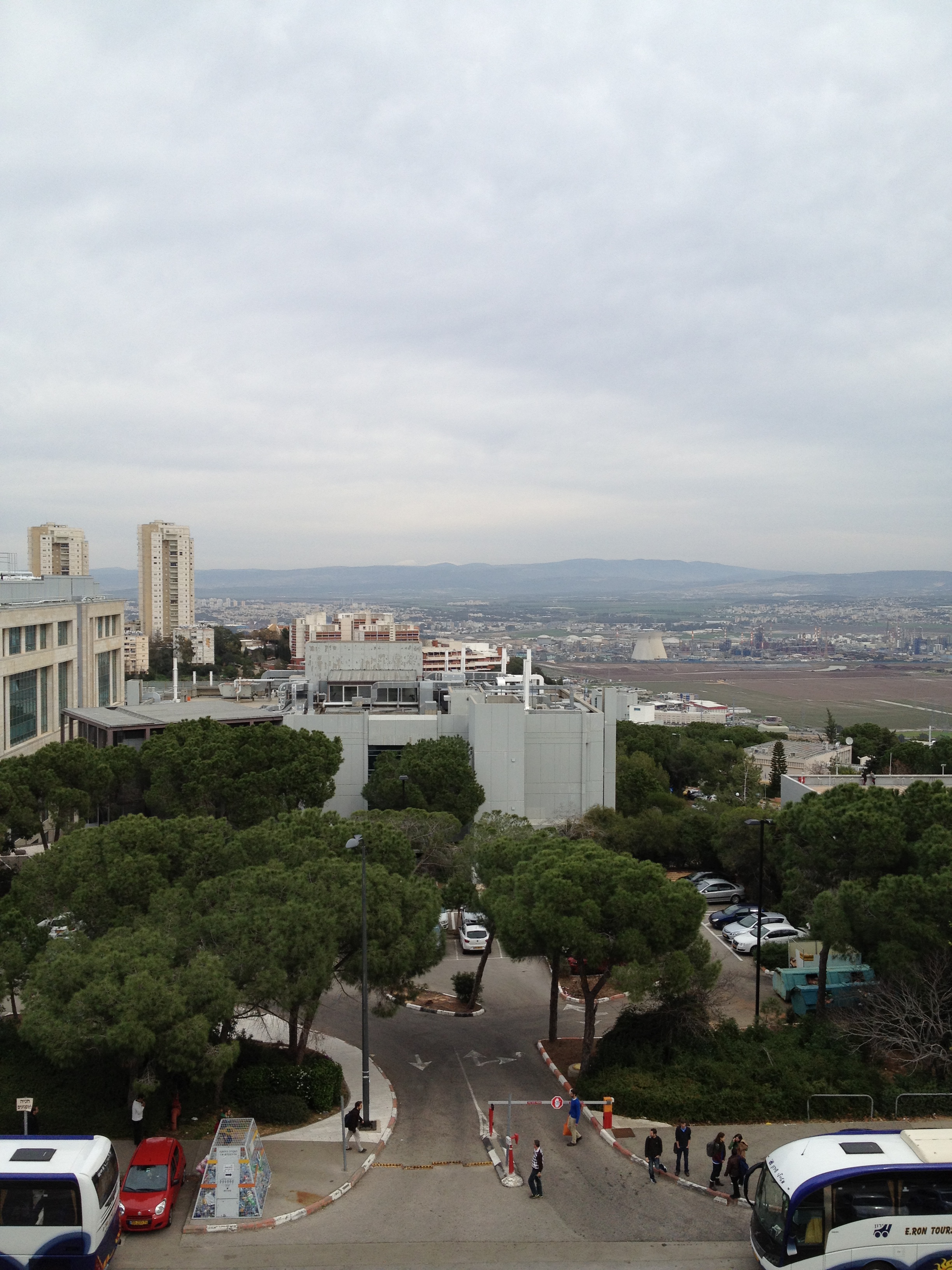
| When the visibility is perfect, this is how the Hermon mountain
(60 miles [96.5 KM] from Haifa) is seen from my office: (Click on the picture to see the full sight [Dani B., 07/01/2003], and a new picture shot ten years later [Mira S., 29/01/2013]) |

|
You are viewer number  (and counting) of this page.