

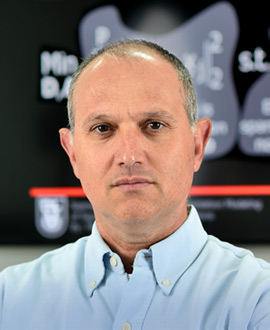

Michael Elad is a Professor in the Computer Science Department of the Technion - Israel Institute of Technology. His fields of interest include signal processing, image processing, and computer vision; numerical analysis, numerical linear algebra and Machine learning algorithms. Follow the links at the top of the page to learn more...
What's new?

May 25, 2012 - Just returned from SIAM Imaging-Science 2012, a great conference for discussing the interface between image processing and applied mathematics. In my opinion, this is the best event available to our community (those working on image processing from a mathematical stand-point) today, far better than ICIP, ICASSP, CVPR, ECCV, and ICCV. Not surprizingly, the main theme of the event was SPARSITY, with numerous talks dedicated to its role in image processing. In retrospect, I think that the name SIAM fits this conference very much, as the acronym "Sparsity in Imaging And More (SIAM)" describes this event very accurately.

I gave two talks in this meeting, the first on the analysis co-sparse model (a short version of the LVA/ICA talk, see below) and the second on a wavelet transform for non-uniformly sampled data. Both can be found HERE. The second talk on the non-conventional wavelet transform covers work done with Idan Ram and Israel Cohen, both from the EE department at the Technion. Among other things, we show that the designed wavelet transform can also be appled to "traditional signals" such as images, by slicing the signal into overlapping patches and treating those as a cloud of points. The surprize is the efficiency with which this new transform operates on images, as we demonstrate in the talk and the preceding papers. In a nut-shell, there are interesting connections between our method and what BM3D does, which explains why we are getting such effective image denoising with the new scheme.

March 15, 2012 - An extensive work has been dedicated in the past decade to the study of sprasity and redundancy in signal and image processing. However, most of this work took a specific point of view, one which we refer to as the "synthesis model". As this name may suggest, it appears that there is an alternative, "Analysis Model", that could be considered as well. In the past 2-3 years, several groups of researchers started looking more closely at this alternative. In a joint EU project (called SMALL) with Remi Gribonval from INRIA Rennes, Mike Davies from the university of Edinbrough, Mark Plumbley from Queen-Mary, London, and several others, we managed to define the analyis model as a generative one, tie interesting connections to the synthesis counterpart approach, develop several pursuit methods that denoise "analysis co-sparse signals" and study their performance, and even started working on the dicitonary learning problem. I gave a keynote talk in the LVA/ICA conference on the Analysis Co-Sparse model, exposing our recent results on this interesting front. The slides can be found HERE.

November 21, 2011 - Recognizing the achievements of its members is an important part of the mission of the IEEE. Each year, following a rigorous evaluation procedure, the IEEE Fellow Committee recommends a select group of recipients for one of the Association’s most prestigious honors, elevation to IEEE Fellow. I have just been informed that the IEEE Board of Directors, at its November 2011 meeting, elevated me to IEEE Fellow, effective 1 January 2012, with the following citation: "for contributions to sparsity-and-redundancy in image processing".

October 3, 2010 - In February 2009, Freddy Bruckstein, David Donoho, and I published a paper in SIAM-Review (SIAM Rev. 51[1]: 34-81, March 2009) on sparse represnetations,
covering this topic from initial theoretical ideas, and all the way to applications in image processing. Few weeks ago we have been notified that "this article has been identified by Thomson Reuters Essential Science Indicators as a featured Fast-Breaking Paper in the field of Mathematics, which means it is one of the most-cited papers in this discipline published during the past two years". Information about this article and the story behind it are now featured in Thomson Reuters ScienceWatch.

September 14, 2010 - My new book, titled "Sparse and Redundant Representations: From Theory to Applications in Signal and Image Processing", (Springer) is now available. This book provides a reader-friendly and comprehensive view of the field of sparse approxmation, and its impact to image processing. The book offers a systematic and ordered exposure to the theoretical foundations of this field, the numerical aspects of the involved algorithms, and the signal and image processing applications that benefit from these advancements.
Originally written to serve as a text-book for a graduate engineering course, this book is an easy entry-point for inetrested readers, and for others already active in this area. See Amazon for more details. A Matlab package that reproduces the book's figures and contains most of the discussed algorithms is available HERE.


Phone: (+972) 4-829-4169
Fax: (+972) 4-829-4353 or 3900
Email:elad@cs.technion.ac.il
Office: Taub building 438, Technion
Mailing address:
   Computer Science Department
   Technion City
   32000 Haifa, Israel
Teaching Research Resume Publications Talks Collaborators Software